The Hidden Friction in Post-Military Growth
For many military veterans transitioning into business ownership, the initial hurdles to success are rarely a lack of operational discipline, tactical adaptability, or strategic vision. Instead, the friction is structural and linguistic. The military-civilian gap represents a silent operational barrier that can stall venture development, partner acquisition, and mid-market contracting. Research indicates that while veteran entrepreneurs possess highly refined leadership and risk-management capabilities, these core strengths are frequently lost in translation. Without a systematic method to bridge this divide, veteran-owned businesses risk being overlooked in highly competitive markets simply because their value propositions are articulated in a vocabulary unfamiliar to civilian enterprise leaders.
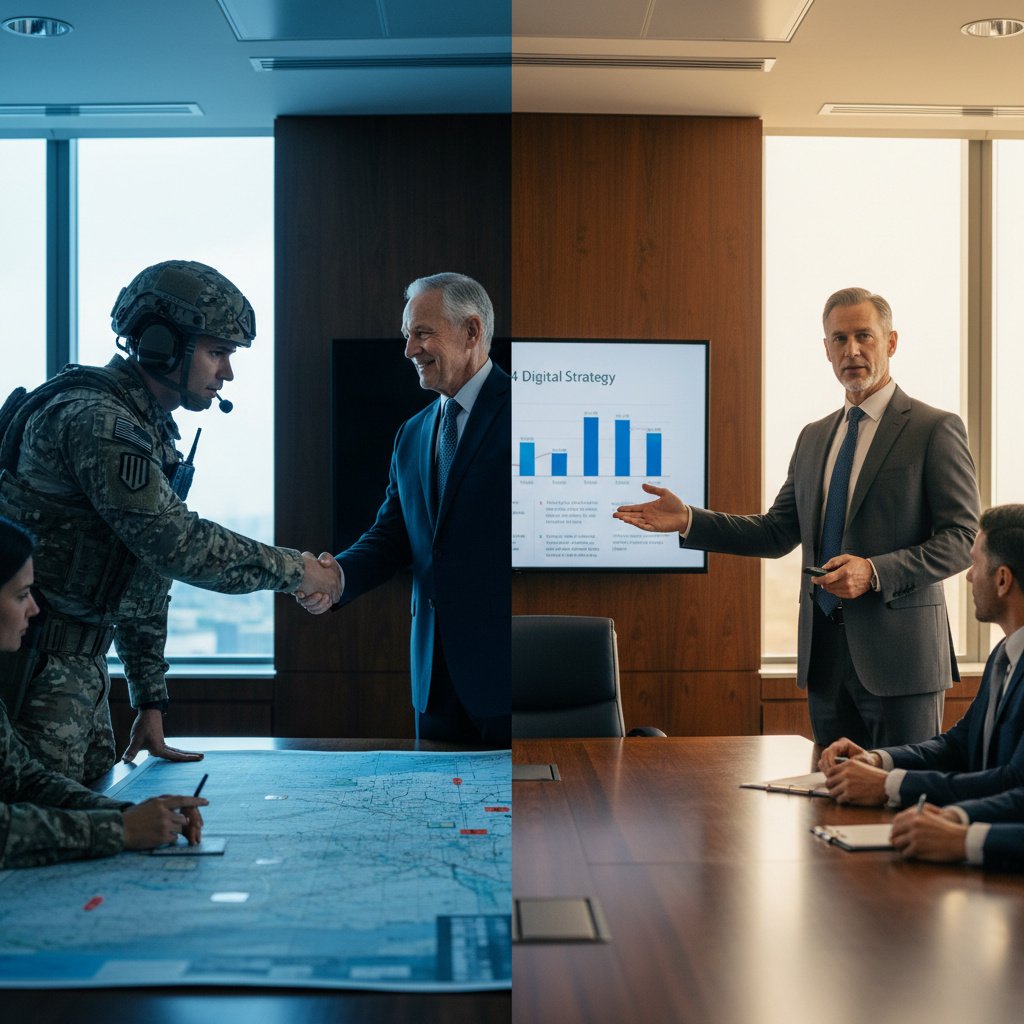
This is where the tactical execution of cultural bridging becomes an essential growth mechanism for veteran-owned enterprises. Rather than functioning as a soft support system, structured mentorship operates as a functional business accelerator. Veteran mentors, possessing lived execution experience inside both ecosystems, serve as strategic cultural translators who dismantle these communication boundaries, facilitating market integration and unlocking high-value contracts that might otherwise remain entirely out of reach.
The Economics of Cultural Translation
The primary hurdle for veteran business owners attempting to secure corporate procurement opportunities is rarely a capability deficiency; it is a packaging problem. Military operations rely heavily on highly standardized nomenclature, rigid classification systems, and direct vertical command lines. Conversely, civilian organizations function within matrixed structures, subtle influence dynamics, and rapidly evolving business vocabulary. Veteran mentors act as essential translators, decoding the complexities of the civilian ecosystem and assisting veteran founders in converting military logistics, resource deployment, and tactical execution into the precise terms that civilian corporate decision-makers expect and respect.
The quantitative value of this cultural translation is substantial. Independent studies indicate that when a mentor assists a transitioning professional with resume and portfolio alignment, the individual is twice as likely to secure employment. When that mentorship extends directly to interview preparation and business presentations, the success rate increases threefold. For veteran business owners, these metrics translate directly to the capability statement and pitch process. A veteran mentor helping a founder refine a business proposal can mean the distinction between losing a bid due to jargon-heavy packaging and securing a multi-year corporate partnership.
Consider the trajectory of a former military logistics officer who launched a commercial asset distribution firm. Initially, her business development materials mirrored her service profile: high-stress logistics management, remote supply-chain orchestration, and rapid tactical troop deployment. To a corporate procurement director, these terms felt disconnected from commercial retail needs. A veteran mentor stepped in to initiate a systematic rewrite, translating “military transportation management” to “just-in-time fleet optimization and localized supply-chain risk mitigation.” This precise adaptation of terminology allowed the distribution firm to secure its first major regional logistics contract within four months.
The Value of a Shared Language
While civilian business consultants can provide general operational feedback, they often struggle to connect with the deep-seated cultural mindset of military service. Veteran mentors bring an unmatched level of mutual trust and respect. Because they have worn the uniform and successfully navigated the civilian commercial market themselves, they speak a shared language. This shared identity quickly minimizes administrative friction, enabling candid, highly developmental, and direct feedback loops that civilian counterparts cannot easily establish.
This unique peer-to-peer trust is vital when navigating the psychological shift required to build an integrated corporate identity. For veteran business owners, the goal is not to abandon their military heritage but to combine their service experience with the commercial agility required to compete. Veteran mentors serve as living proof-of-concept models for this integration. They demonstrate how to honor a commitment to service while fully adopting the aggressive, profit-driven strategies required to scale a sustainable enterprise.
Navigating Workplace Integration and Corporate Culture
For veteran-owned businesses seeking to scale, workplace integration is not just about personal adjustment; it is about building a cohesive team culture that blends diverse backgrounds. Veteran business owners often face a steep learning curve regarding loose corporate hierarchies, complex private benefit structures, and the consensus-building models characteristic of large civilian corporations. Mentors help demystify these unwritten rules, preparing business owners to manage mixed civilian-veteran workforces and present business cases comfortably to corporate boards.
Organizations like American Corporate Partners (ACP) have systematized this form of corporate connection, linking veterans with corporate executives from top-tier firms like IBM, GE, and Johnson & Johnson. Similarly, programs such as the Joining Forces for Women Veterans Mentorship Program actively connect female veteran entrepreneurs with seasoned mentors. These initiatives demonstrate that when veteran founders understand the structural expectations of civilian organizations, their speed-to-market increases, and their businesses scale with far greater predictability.
A Tactical Framework for Mentoring Relationships
To extract maximum strategic value from mentorship, veteran corporate leaders should approach these relationships with structured intentionality. High-impact mentorship requires tactical action steps:
- Establish Clear Boundaries and Expectations: Determine the exact parameters of the engagement from the initial meeting. Clarify communication cadence, expectations for introductions to professional networks, and how specific objectives will be measured.
- Embrace Tactical Discomfort: An effective mentor will push a business owner outside of their operating comfort zone. While the civilian business sector may appear familiar on the surface, its underlying mechanics are vastly different. Assume that your business methods will need adaptation to scale.
- Formulate a Structured Action Plan: Every mentorship session must conclude with concrete, measurable deliverables. Track progress against defined business development goals, whether that involves refining a core capability statement, rebuilding a marketing pitch deck, or target-mapping high-value corporate partners.
- Leverage Collective Networks: Seek out veteran employee resource groups (ERGs), peer-to-peer circles, and business mentoring networks. Utilizing this collective intelligence creates a powerful multiplier effect, offering a continuous sounding board for navigating challenging corporate integrations and operational scaling hurdles.
A Strategic Asset Class
In a highly competitive commercial environment, veteran business owners cannot afford to let communication barriers slow their market expansion. Mentorship is not an act of charity; it is a highly strategic business asset class that yields quantifiable economic returns. By utilizing veteran mentors as cultural translators, veteran entrepreneurs can bridge the persistent military-civilian gap, translate raw operational capability into strategic corporate value, and position their businesses for long-term market leadership.
Book a 15 minute discovery call to find out more today at https://digifidelis.com/calendar/
Recent Comments